How to Add Distance to Your Golf Swing

Every amateur golfer wants more distance. Fifteen extra yards off the tee turns a driving-iron approach into a wedge. Ten extra yards with a 7-iron means one less club into every green. The reason distance matters is simple: shorter clubs into targets means better scoring.
Most golfers try to add distance the wrong way - by swinging harder. Muscles tighten, the arms cut off from the body, and the ball actually travels shorter. Real distance comes from a combination of three things: how fast the clubhead is moving, how cleanly you strike the middle of the face, and the angle at which the club meets the ball. Fix all three and you can add 20 to 30 yards without ever swinging out of your shoes.
Straight to the Pin
Distance comes from three things, not one. Clubhead speed (a wider arc and a full shoulder turn create speed without effort), centre-face contact (hitting the sweet spot adds 15-20 yards over a mishit), and angle of attack (swinging up on the driver, sweeping through fairway woods, striking down on irons). To swing further: widen the takeaway, turn your shoulders fully, let the ground help you by shifting weight into the lead foot in the downswing, and loosen your grip. If you're stuck at the same yardages no matter how hard you swing, one lesson with a PGA pro will find the leak in five minutes.
What Actually Creates Distance
Three inputs decide how far the ball travels:
1. Clubhead speed The faster the head is moving at impact, the further the ball goes. Every 1 mph of driver clubhead speed adds roughly 2.5 yards of total distance. Amateur men typically swing driver at 85-95 mph. Tour pros average around 115 mph.
2. Smash factor (centre-face contact) This is the ratio of ball speed to clubhead speed. A pure centre strike gives a smash factor of roughly 1.5 with a driver - the ball comes off the face 50% faster than the club is moving. A strike off the toe or heel drops that to 1.35 or below, which can cost you 20 yards from the same swing speed.
3. Angle of attack Whether the club is moving up, level, or down through impact. For a driver, an upward angle of attack of 3-5° adds distance because it launches the ball higher with less spin - the ideal combination for carry. For irons, a downward angle of attack compresses the ball and generates spin, which controls the flight.
You cannot bully your way to more distance. You need all three working together.
Where Amateurs Lose Distance
Before adding new moves, check what you're already losing.
Narrow swing arc A takeaway that starts short and steep never generates real speed. The clubhead travels a much shorter distance than in a wide, full swing, so it simply cannot accelerate to the same peak.
Short backswing turn If your shoulders only turn 60-70° instead of 90°, you've cut your potential range by a third. Speed is proportional to how much arc the clubhead travels through.
Casting (throwing from the top) Releasing the wrist angle too early in the downswing dumps all your stored energy before impact. The clubhead is moving fastest halfway down the swing, not at the ball. Feels powerful, delivers nothing.
Tight grip pressure White knuckles at address kill wrist speed. The wrists are the biggest speed generator in the swing - they whip the club through impact. A grip pressure of 4 or 5 out of 10 lets them work. A grip pressure of 9 out of 10 turns your swing into a slow shove.
Weight staying back Amateurs who lean back at impact rob themselves of both speed and centre-face contact. The weight transfer into the lead foot is what allows the ground to push back through the swing - physics call it ground reaction force. Every long hitter has one, whether they know it or not.
Building Real Distance: The Six Fundamentals
1. Widen the takeaway The first three feet of the backswing sets the arc for the whole swing. Feel your lead arm pushing the club away from the ball as one piece with your chest. If your hands are the first thing to move, the arc will collapse.
2. Complete the shoulder turn At the top of the backswing, feel your back facing the target. If you can see your target out of the corner of your eye at the top, you haven't turned enough. A full turn stretches the muscles between the trail hip and the lead shoulder - the "power coil" that unwinds through the ball.
3. Sequence the downswing from the ground up The first move down should be a small weight shift into the lead foot, then the hips rotating, then the arms following. The club is the last thing to move. Amateurs who start the downswing with the arms lose the leverage of the whole body and end up hitting with just their hands.
4. Let the wrists hold their angle The angle between the shaft and your lead arm at the top of the swing (the "wrist cock") should stay set well into the downswing. The wrists release naturally through impact - you don't need to force it. This is what creates the whip-like acceleration through the ball.
5. Loosen the grip Grip pressure like you're holding a small bird - firm enough that it can't fly away, gentle enough that you don't crush it. Tight forearms cannot generate speed.
6. Finish balanced If you can hold your finish position for three seconds after the ball is gone, your weight shifted correctly. If you're falling forward or backward, energy leaked somewhere in the swing.
Note
Feel is not always real. Most golfers who think they're swinging at 80% are actually swinging at 100% - and losing distance in the process. On the range, try hitting shots at what feels like 70% effort. Your yardages will usually match or beat your full-effort swings, because the tempo is smoother and the strike is cleaner.
Three Drills for More Distance
Drill 1: Feet-together swings Stand with your feet touching. Hit shots at three-quarter speed. Any attempt to swing hard will cost you balance immediately - the drill forces you to swing smoothly and rotate correctly. Ten balls at the start of every range session builds tempo and centre-face contact.
Drill 2: Step drill Set up with your feet together. As you start the backswing, step your lead foot into your normal address position. This teaches the ground-up downswing sequence - the lead foot plants first, then the hips rotate, then the arms follow. It's the single best drill for weight transfer.
Drill 3: Long-club, short-club challenge Hit ten balls with your driver at 80% effort. Then ten balls with your 7-iron at 100%. Compare the ball speeds if you have a launch monitor, or just the distances if not. Most amateurs hit the 80% driver as far as they hit the 100% driver - proof that effort and distance are not the same thing.
The Fitness Side
Speed also comes from what your body can physically do. Two areas make the biggest difference for amateur golfers:
Rotational mobility The ability to turn your shoulders 90° at the top of the backswing while the hips resist. Most people over 40 lose this range gradually, and it's the number one cause of distance loss with age. Simple thoracic mobility exercises - seated spinal twists, foam roller work, cat-cow - take five minutes a day and reverse most of that loss.
Hip strength and stability The downswing sequence depends on the hips being able to rotate quickly under load. Weak or tight hips force the arms to take over. Basic glute exercises (bridges, single-leg deadlifts, banded lateral walks) two or three times a week improve both stability and rotational speed.
You don't need to be an athlete to swing faster. But you do need a body that can move through the positions your swing wants to make.
Realistic Expectations
Adding 20 yards is a genuine, achievable target for most amateurs - but it comes from a combination of technique, tempo, and equipment, not from any single fix. Realistic timeline:
- Immediate (one session): 5-10 yards from setup adjustments, grip pressure, and a wider takeaway
- Four to six weeks: another 5-10 yards as new movement patterns become natural
- Three to six months with lessons and practice: 15-25 yards total gain
- Twelve months with dedicated training: 25-40 yards is possible for younger and more athletic golfers
Golfers over 60 can still add distance, though the balance shifts from raw speed to strike quality and equipment fit. A properly-fitted driver with the right loft, shaft flex, and length often unlocks distance that no amount of range work will find on the wrong club.
When to Get a Lesson
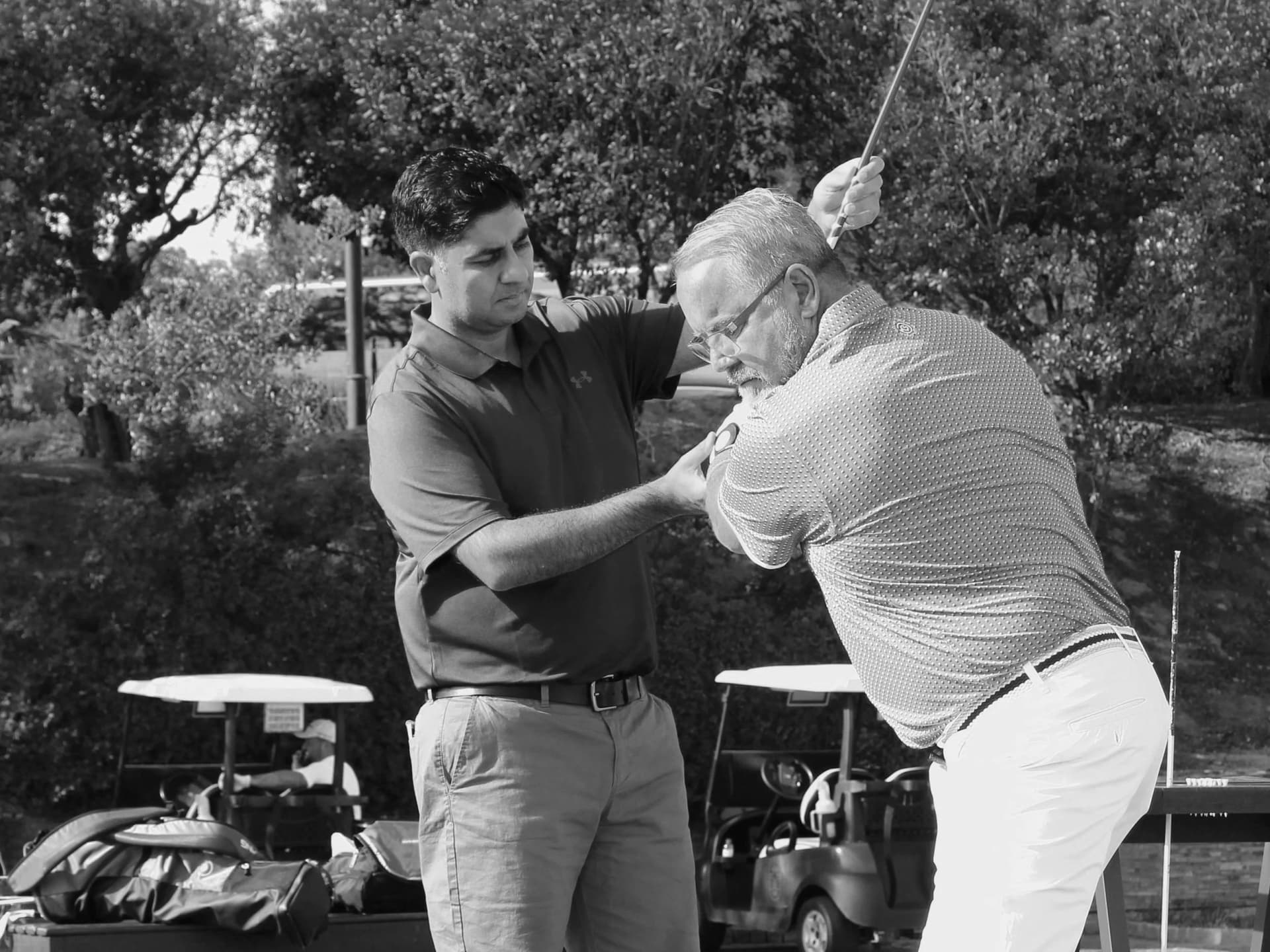
Distance work is one of the fastest and most satisfying areas a PGA pro can help with - because launch monitor data lets you see exactly which of the three inputs (speed, contact, angle) is limiting you. Once you know where the leak is, the fix is usually a small change that adds yards immediately. If you've plateaued, one data-driven lesson is worth ten trips to the range.
Browse golf lesson vouchers or use our Gift Finder to find the right lesson type for your game.
See also: how to hit a driver, how to hit fairway woods and hybrids, how to improve your golf swing, golf fitness exercises.
Founder & Tour Professional
Sandeep Grewal is a former tour professional and the founder of Swyng. He personally handles every booking and redemption.
About Sandeep