The Golf Swing Takeaway: How the First Two Feet Decide Everything
The takeaway is the first move of the golf swing - the two-foot journey from address to the point where the clubshaft is roughly parallel to the ground. It lasts less than half a second and it decides more about the swing that follows than almost any other position. A wide, connected takeaway sets up a swing that turns fully, coils properly, and delivers the club on plane. A narrow, wristy takeaway is what most amateur swing faults are built on.
Fix the first two feet of the swing and the rest of it starts to work. Chase the fault that shows up at impact - the slice, the fat shot, the topped iron - and you'll usually find the cause was set in the first foot of the takeaway. This is one of the best-value swing changes any amateur can make, because it does not require athleticism or flexibility. It requires only that you understand the correct move and rehearse it.
Straight to the Pin
The takeaway is the first two feet of the backswing - the move from address to when the shaft is parallel to the ground. Correct move: the club, hands, arms, and chest move together as one piece, low and wide, with no early wrist hinge and no rotation of the hands. Check point: at shaft-parallel, the butt of the club should point roughly at the target line and the clubface should be square to your spine angle (a "toe-up" position for most swings). If your takeaway is wristy or narrow, a lesson with a PGA pro can rebuild it in one session - and every other part of the swing benefits.
Why the Takeaway Matters So Much
Everything in the golf swing is a reaction to what came before it. The finish reacts to the impact position. Impact reacts to the transition. The transition reacts to the top of the backswing. And the top of the backswing reacts to the takeaway.
Compensations pile up quickly. A wristy takeaway forces the arms to reroute the club on the way up, which changes the top position, which changes the transition, which changes the impact. By the time the club reaches the ball, three or four small errors have combined into one large one.
The takeaway is worth focusing on because:
- It's slow and controllable. Unlike impact, which happens in a fraction of a second, the takeaway is deliberate. You can rehearse it in front of a mirror and check every detail.
- It's the same for every full-swing club. Driver, iron, wedge - the takeaway looks nearly identical. One good move covers most of the bag.
- Fixing it is felt, not forced. Once you understand the correct move, it feels natural. It doesn't require strength or flexibility, just intention.
What the Takeaway Should Look Like
The move from address to the halfway-back position (shaft parallel to the ground, roughly waist high) should have four characteristics.
One-piece motion The club, hands, arms, and chest move away from the ball as a single unit. If the hands and arms move but the chest stays still, the takeaway is disconnected. If the wrists hinge early, the club goes inside too quickly. The goal is a feeling of everything moving together.
Low and wide The clubhead stays low to the ground for the first foot or so of the takeaway. It travels in a wide arc, not a steep one. This width is what allows a full, powerful backswing to happen later - a narrow takeaway leads to a narrow overall arc, and there's no way to recover it once the swing is under way.
No forearm rotation The forearms should stay in the same relative position as at address. If the lead arm rotates away from the body (opening the clubface) or the trail arm rotates towards the body (closing the face), the takeaway is off. This is the fault behind most slices - the face gets open early and stays open all the way to impact.
No early wrist hinge The wrists remain quiet until the club is past waist high. Some hinge begins to appear naturally as the club continues upward, but forcing an early hinge steepens the swing and produces a chopping downward strike.
Two Simple Checkpoints
You can check whether your takeaway is on plane by pausing at two positions.
Checkpoint 1: The three-inch move After three inches of takeaway, the clubhead should still be low to the ground and the hands should have moved only slightly. If the club has already moved to the inside or lifted upwards, the takeaway is off.
Checkpoint 2: Shaft parallel (the halfway-back position) When the clubshaft is parallel to the ground, check three things in a mirror or on video:
- The butt of the club should point roughly at the target line (or an extension of it behind you)
- The clubface should be square to your spine angle - if you're bent over the ball, the clubface is angled to match, not vertical
- Your hands should be roughly in line with your trail leg, not far in front of or behind it
If the club goes across the target line ("laid off") or well outside it ("across the line"), the takeaway needs work. Most amateurs err on the "inside and shut" side - too flat, too closed - which sets up a slice.
Note
The "toe-up" position at shaft-parallel is the traditional teaching, but for many players (especially those with a stronger grip) the clubface will actually be angled slightly closed relative to vertical - matched to their spine angle. The key is not the absolute angle of the face, but that it is consistent with your spine tilt.
Common Takeaway Faults
Rolling the forearms open The clubface opens dramatically in the first foot of the takeaway - visible in a video because you can see the leading edge of the club rotating upwards. Common in golfers trying to "extend" the takeaway. Cause of slices, thin iron shots, and blocks to the right. Fix: feel like the clubhead stays "square" to your body as it moves back - the leading edge doesn't rotate.
Snatching inside The clubhead pulls to the inside almost immediately, going too flat too quickly. Common in golfers trying to swing "on plane" but overcorrecting. Cause of thin shots and hooks. Fix: feel the clubhead stay outside your hands in the first foot of takeaway. Extend the club straight back, not around your body.
Lifting the club The clubhead comes off the ground quickly and the swing becomes upright and steep. Common in tall golfers or those who feel they should "get the club up high". Cause of steep, chopping downswings, fat and thin contact. Fix: feel the clubhead brush the grass for the first foot of takeaway.
Wristing it back The wrists hinge sharply in the first foot, breaking the club upwards without much shoulder turn. Common in golfers with tight shoulders or those trying to "cock" the wrists early. Cause of loss of width and a steep, arms-only swing. Fix: keep the wrists passive for the first waist-high move. Let hinge develop naturally after that.
Everything moving in isolation Hands lift, wrists hinge, chest doesn't turn - the takeaway becomes a series of arm and hand moves instead of a coordinated whole. Cause of inconsistency across the board. Fix: think "chest turns, arms follow" as the swing thought for the takeaway.
Three Drills to Groove a Better Takeaway
Drill 1: The two-club drill Take two clubs and hold them together, one in each hand, or hold a club in your normal grip with an alignment stick pressed against your chest with your lead arm. Make slow-motion takeaways to waist high. If the chest and arms are moving together, the sticks or clubs will stay in relative position. If they separate, one has moved without the other - the takeaway is disconnected. Repeat until the move feels one-piece.
Drill 2: The tee behind the ball Set a tee in the ground two inches behind your ball (aligned with your intended takeaway line). As you start the takeaway, your goal is to "brush" the tee with the clubhead as it passes over. This forces a low, wide takeaway. If the clubhead lifts or moves inside, you'll miss the tee. Practice in slow motion at first, then at full speed.
Drill 3: Mirror rehearsal Set up facing a full-length mirror (turned to a face-on angle so you can see yourself from the side). Make slow takeaways to shaft-parallel and hold the position. Check the three checkpoints: butt of the club pointing at target line, clubface square to spine, hands in line with the trail leg. This is the single most efficient way to build a correct takeaway because you get instant visual feedback. Even five minutes a day for a week transforms most amateurs' takeaways.
The Takeaway Trigger
Many good players have a small physical trigger that starts the swing - a forward press of the hands, a small hip bump, a kick of the trail knee. The purpose is to get the body moving so the takeaway is not initiated from a static position. Static starts often lead to snatched takeaways because the golfer has to overcome inertia with a jerk.
If your takeaway feels tense or jerky, try a small trigger. Options:
- A slight forward press of the hands towards the target
- A tiny hip bump towards the target
- A small waggle of the club before starting back
- A single deep breath at address, with the exhale timed to the start of the takeaway
Pick one and use it consistently. The trigger itself matters less than having something to convert a static start into a moving one.
When to Get a Lesson
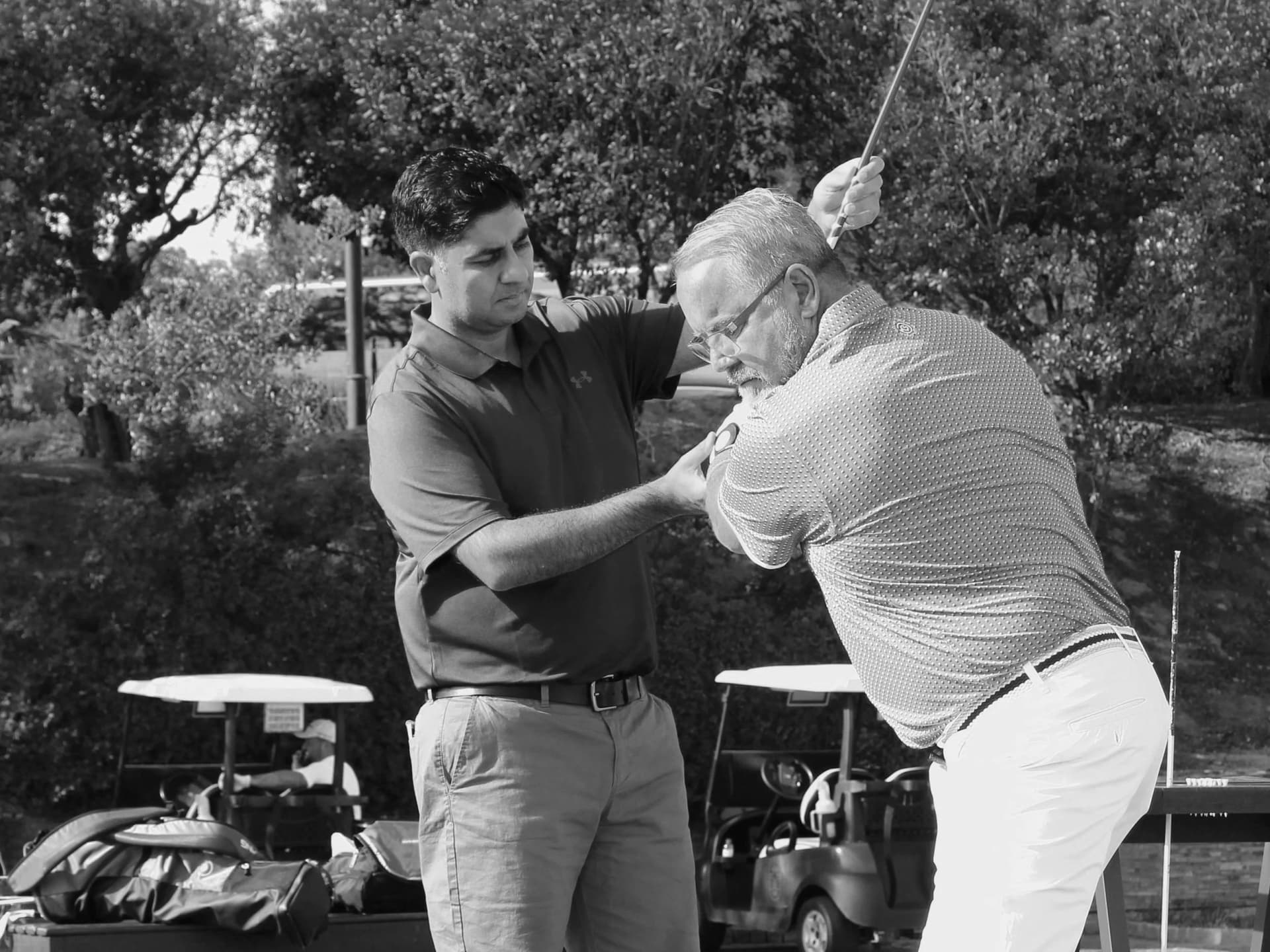
The takeaway is one of the fastest things a PGA pro can fix. On video, faults are visible in the first frame of the swing, and correcting them is usually a matter of feel more than mechanics. If you've been struggling with the same swing issue for years, there's a very good chance the cause is in the takeaway - and a takeaway-focused lesson pays for itself immediately.
Browse golf lesson vouchers or use our Gift Finder to find the right lesson type for your game.
See also: how to improve your golf swing, how to stop slicing the ball, golf swing tempo, how to grip a golf club.
Founder & Tour Professional
Sandeep Grewal is a former tour professional and the founder of Swyng. He personally handles every booking and redemption.
About Sandeep