How to Improve Your Golf Swing: Practical Tips for Every Level

There's no shortage of swing advice in golf. YouTube tutorials, magazine tips, advice from playing partners - the information is endless. The problem is that most of it contradicts itself, and none of it is tailored to your specific swing.
What follows isn't a complete technical overhaul. It's a set of reliable principles that make the biggest difference for the widest range of golfers.
Straight to the Pin
Most gains come before the club moves: nail your grip, alignment, and ball position at setup. Then keep the takeaway low and one-piece, turn rather than slide on the backswing, let the lower body lead the transition, swing through the ball, not at it, and finish balanced. Even tempo beats raw speed. The fastest way to improve, though, is one hour with a PGA pro who can watch you swing and name the one or two things holding you back, rather than working through a list on your own.
Start With the Setup
Most swing problems start before the swing begins. Check these three things before worrying about anything else:
Grip: Neutral grip pressure, two to two-and-a-half knuckles showing on the lead hand. If your grip is off, the swing has no chance.
Alignment: Stand behind the ball, pick a target, and set up parallel to the target line - not aimed at the target. Your feet, hips, and shoulders should all be parallel left of target (for right-handers). Most amateur golfers aim too far right.
Ball position: For irons, the ball should sit roughly in the centre of your stance. For woods and driver, move it towards your lead foot. Getting this wrong causes fat shots, thin shots, and inconsistent contact regardless of how good your swing is.
Top Tip
Before every practice session, lay two clubs on the ground - one pointing at your target, one across your feet. This takes 10 seconds and eliminates alignment guesswork.
The Takeaway
The first 18 inches of the backswing set the tone for everything that follows. Keep the clubhead low to the ground, moving in one piece with the hands, arms, and shoulders. Avoid picking the club up steeply with the hands - this leads to an over-the-top downswing and pulled shots.
A good drill: put a headcover or tee behind the ball, a foot or so along the target line. Your takeaway should brush past it as the club moves back.
Turn, Don't Slide
During the backswing, the goal is to rotate around your spine, not to slide your hips to the right. Feel your weight transfer to the inside of your back foot as you turn - not to the outside.
At the top of the backswing, your lead shoulder should be over your back foot and your back should be facing the target. If you're struggling to get there, loosen up - tension in the hips and torso is usually the culprit.
The Transition
The transition from backswing to downswing is where most amateur swings fall apart. The instinct is to start the downswing with the arms and shoulders. The correct sequence is the opposite: the lower body leads.
As you reach the top of the backswing, the first move down is a slight shift of the hips towards the target, then a rotation. The arms and club follow. This is the "kinematic sequence" you'll hear coaches talk about - it's what creates power and creates the inside-out swing path that produces a draw.
Rushing this transition is one of the most common mistakes. Deliberately slow down the first move into the downswing and you'll feel the difference immediately.
Through the Ball, Not at It
Think of the swing as passing through the ball, not stopping at it. Your swing should reach maximum speed just after impact - at the golf ball, not before. Golfers who "hit at" the ball instead of "swinging through" decelerate into impact and lose power and control.
A useful mental image: swing towards a target two feet in front of the ball, not the ball itself.
Finish the Swing
Where you finish tells you a lot about what happened through the swing. A good finish position looks like this:
- Your belt buckle faces the target (or slightly left of it for right-handers)
- Your weight is almost entirely on your front foot
- Your back foot is balanced on the toe, heel lifted
- The club is over your lead shoulder
- You can hold this position without falling over
If you're off-balance, falling backward, or struggling to finish high, something went wrong earlier. The finish is a consequence - work backward from there.
The Role of Tempo
Many golfers who try to swing "better" actually just swing faster. Speed is not the same as power. Power comes from a well-sequenced swing, not a frantic one.
Try this: count "one" on the backswing and "two" at the start of the downswing. Keep the tempo even. You'll probably hit the ball further than when you swing as hard as you can, because you'll be making better contact.
Practice Drills That Actually Work
Half-swing drill: Hit balls with half your normal swing - 9 o'clock back, 3 o'clock through. Focus on clean contact and clubface control. Most full-swing problems disappear when you slow down.
Impact bag: A foam bag you swing into at impact position. Teaches you what a solid impact position feels like. About £20 online.
Mirror work: Stand facing a full-length mirror and practise your takeaway and backswing. You'll catch alignment, posture, and plane issues that you can't feel from the inside.
The Fastest Way to Improve
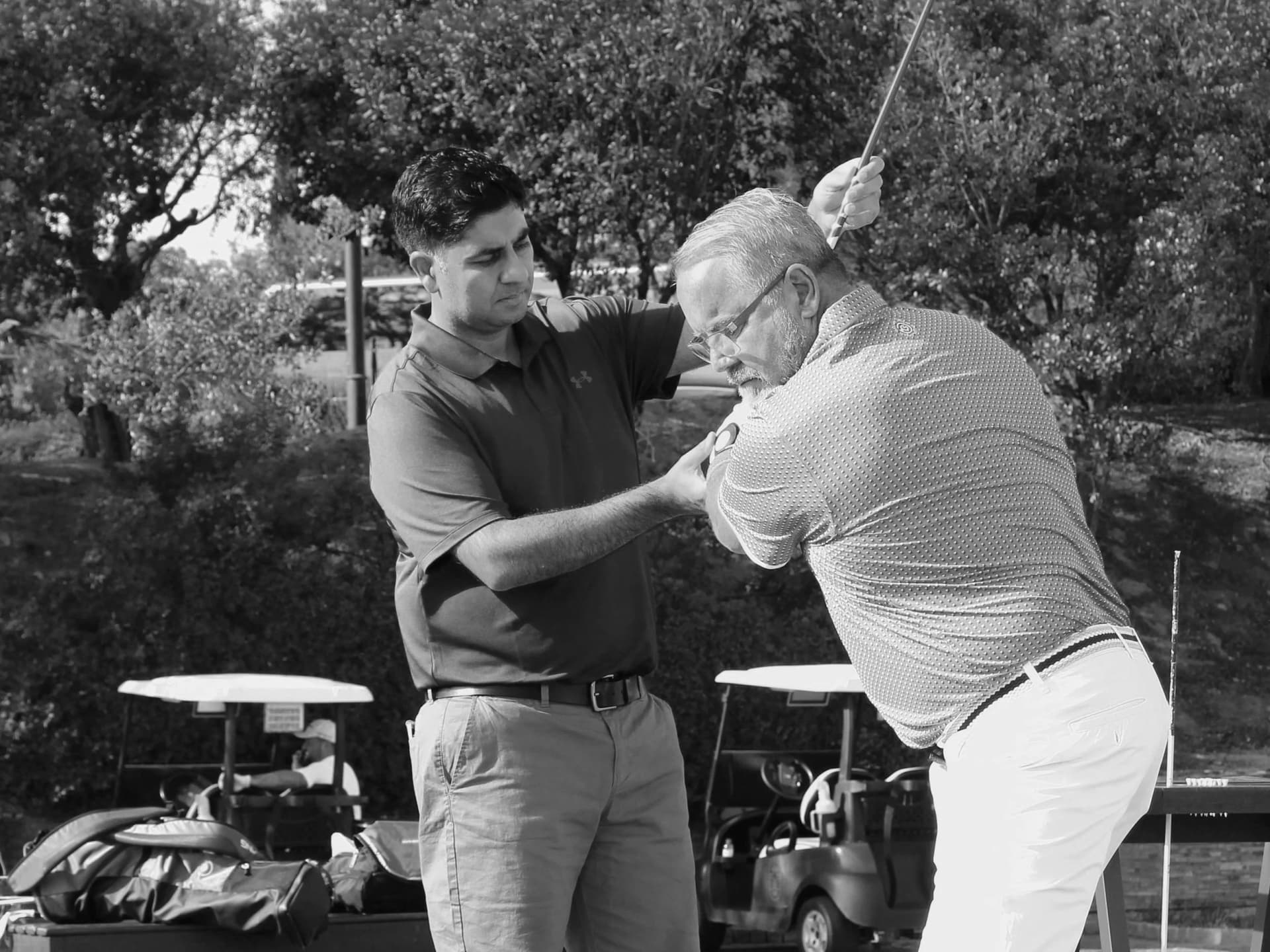
All of the above is useful. But the fastest way to improve your golf swing is one lesson with a PGA professional who can watch you swing and identify the one or two things that will make the biggest difference.
Not five things. Not ten. One or two. The rest can wait.
Generic advice - including this article - can only take you so far. A professional sees your swing, not a description of it.
Book a lesson with a PGA professional through swyng.co.uk and get specific feedback on your swing.
Founder & Tour Professional
Sandeep Grewal is a former tour professional and the founder of Swyng. He personally handles every booking and redemption.
About Sandeep