How to Grip a Golf Club: The Beginner's Guide to Holding a Club Correctly
Of all the fundamentals in golf, the grip is the most important and the most overlooked. Most beginners pick up a club and hold it however feels natural. The problem is that "natural" usually means holding it like a baseball bat - which leads to a closed face, pulled shots, and frustration.
Getting the grip right takes about five minutes to learn and will improve every shot you hit.
Straight to the Pin
Pick one of the three styles, overlap, interlock, or ten-finger, then build a neutral grip: club across the fingers, thumb down the shaft, and two to two-and-a-half knuckles showing on the lead hand. Keep grip pressure at a 4 or 5 out of 10 so your forearms stay loose, and check it before every shot. If your ball flight or contact is not responding to grip tweaks, an hour with a PGA pro who can check your hands in person sorts it faster than guessing.
Why the Grip Matters
Your hands are the only part of your body that touches the club. How you hold it determines the angle of the clubface at impact, which determines where the ball goes. A good grip makes it easier to square the face naturally. A bad grip means you're constantly compensating.
The Three Types of Golf Grip
1. The Overlap Grip (Vardon Grip)
The most popular grip among club golfers and professionals. The little finger of the trailing hand (right hand for right-handers) overlaps the index finger of the lead hand.
Good for: most adult golfers with average to large hands.
2. The Interlock Grip
The little finger of the trailing hand interlocks with the index finger of the lead hand. Slightly more secure.
Good for: players with smaller hands, junior golfers. Used by Tiger Woods and Jack Nicklaus.
3. The Ten-Finger Grip (Baseball Grip)
All ten fingers on the club with no overlap or interlock. The most natural feeling for complete beginners.
Good for: children, players with arthritis or weak grip strength, and absolute beginners who find the other grips uncomfortable.
For most beginners, the overlap or interlock grip is the right choice. Start with one of these rather than defaulting to the ten-finger grip, which can create bad habits later.
How to Place Your Hands: Step by Step
Lead Hand (Left Hand for Right-Handers)
- Hold the club in front of you with the face square (pointing straight ahead)
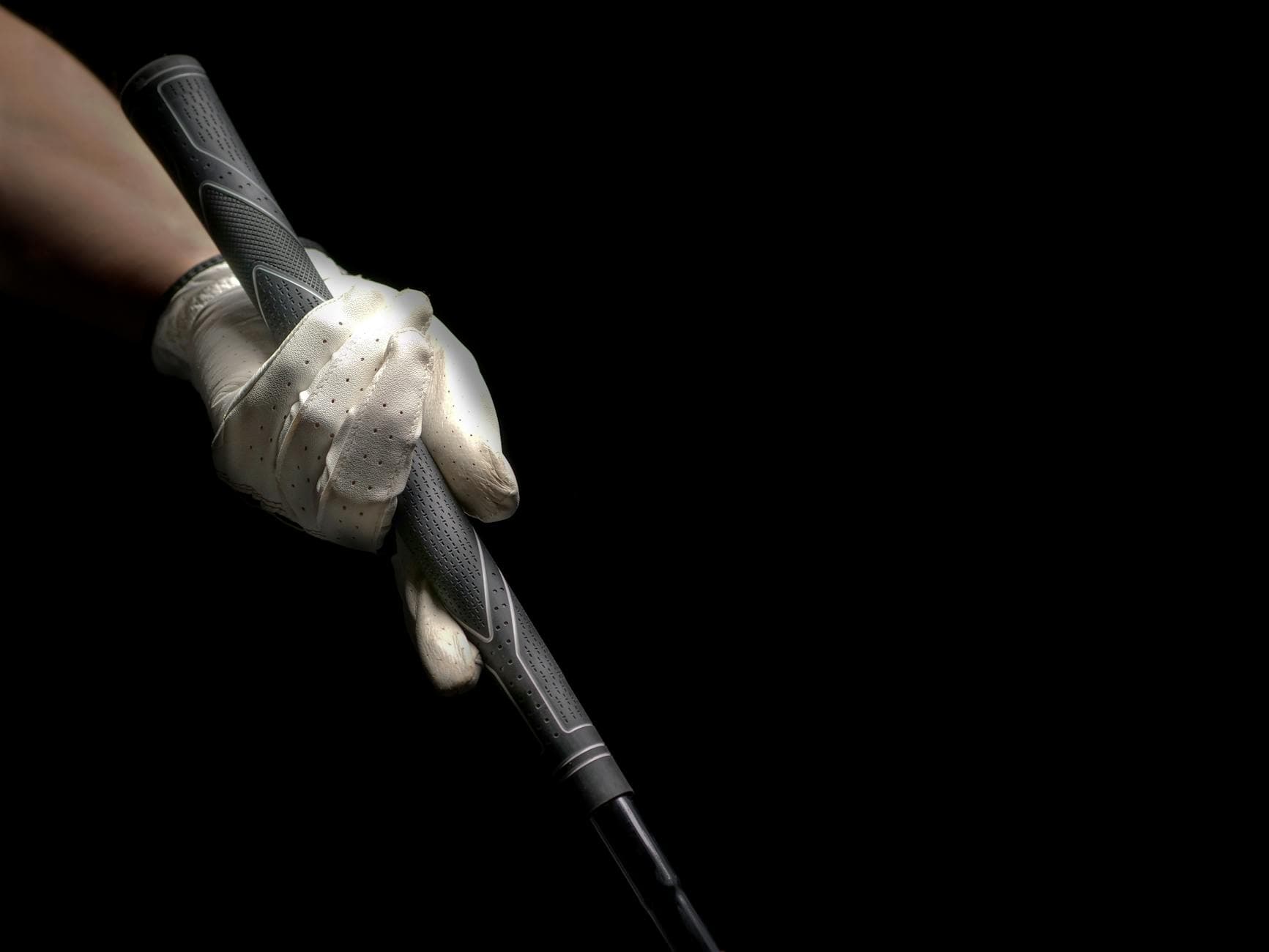
- Place the grip diagonally across the fingers of your left hand - from the base of the little finger to just below the first knuckle of the index finger
- Close your fingers around the grip
- Your thumb should point slightly to the right of centre, down the shaft
- When you look down, you should see two to two-and-a-half knuckles on your left hand
Top Tip
If you see one knuckle, your grip is too weak. If you see four, it's too strong. Two to two-and-a-half is the target.
Trailing Hand (Right Hand for Right-Handers)
- Place the pad of your right hand against your left thumb
- Wrap your fingers underneath the grip
- Your right thumb should sit slightly left of centre on the grip
- The "V" formed by your right thumb and forefinger should point roughly towards your right shoulder
- Apply your chosen grip style: overlap, interlock, or ten-finger
Grip Pressure: The Most Common Mistake
Gripping too tightly is the single most common grip error. Tense forearms kill clubhead speed and make the swing rigid.
Try this: on a scale of 1 to 10, where 10 is as hard as you can squeeze and 1 is barely holding the club, aim for a 4 or 5. Firm enough that the club won't slip. Relaxed enough that your forearms stay loose.
A good way to check: if your forearms are visibly tense at address, you're gripping too hard.
Neutral vs Strong vs Weak Grips
- Neutral grip: two to two-and-a-half knuckles visible - promotes a straighter ball flight
- Strong grip: three or more knuckles visible - tends to promote a draw (right-to-left for right-handers)
- Weak grip: one knuckle visible - tends to promote a fade (left-to-right for right-handers)
Most beginners benefit from a neutral grip to start. As you develop and understand your ball flight, your coach may adjust this.
Check Your Grip Every Time
Before every shot, take a moment to check your grip. It's easy to unconsciously adjust your hands between shots, especially under pressure. Make the grip check part of your pre-shot routine until it becomes second nature.
When to Re-Grip Your Clubs
Old, worn grips become slippery - which leads to gripping even tighter to compensate. Grips should be replaced every 12–18 months for regular players, or when they start to feel smooth. Re-gripping a set of irons costs around £30–£50 at a pro shop.
A solid grip won't transform your game overnight, but it removes one of the most common root causes of poor shots. Get a professional to check yours during your first lesson.
Book a beginner lesson with a PGA professional at swyng.co.uk.
Founder & Tour Professional
Sandeep Grewal is a former tour professional and the founder of Swyng. He personally handles every booking and redemption.
About Sandeep